

Statistics
Beyond Blue uses statistics from trusted references and research.
View some of our most commonly used stats, or find the relevant category from the list below to find the specific information you're looking for.

Beyond Blue uses statistics from trusted references and research.
View some of our most commonly used stats, or find the relevant category from the list below to find the specific information you're looking for.


As an organisation that supports people from across Australia, Beyond Blue acknowledges the Traditional Owners and Custodians of Country and their continuing connection to land, waters and community. We pay respect to Elders past and present.
First Nations Peoples are advised that this website may include reference to and images of deceased persons.
Beyond Blue is committed to safe inclusive spaces, policies and services for people of LGBTIQ+ communities and their families.
Nearly half of all people in Australia have experienced a mental health condition in their lifetime.
In 2020–2022, of the 19.8 million Australians aged 16–85 years, 42.9% (8.5 million people) had experienced a mental condition at some time in their life. 43.6% of females had experienced a mental health condition and 42.2% of males.1
Almost a third of people in Australia have experienced an anxiety disorder* in their lifetime.
In 2020–2022, 28.8% (5.7 million people) had experienced an anxiety disorder such as Social Phobia or Post-Traumatic Stress Disorder in their lifetime. A higher proportion of females (34.2%) than males (23.2%) had experienced an anxiety disorder.1
One in six people in Australia have experienced a mood disorder** - including depression - in their lifetime.
In 2020–2022, 16.0% (3.2 million people) had experienced an affective disorder in their lifetime such as a Depressive Episode. A higher proportion of females (18.5%) than males (13.3%) had experienced an affective disorder. 1
4.3 million people have experienced a mental health condition in the past 12-months.
In 2020–2022, one in five Australians (21.5%) had a 12-month mental disorder. Females (2.5 million, 24.6%) and Males (1.8 million, 18.3%). 1
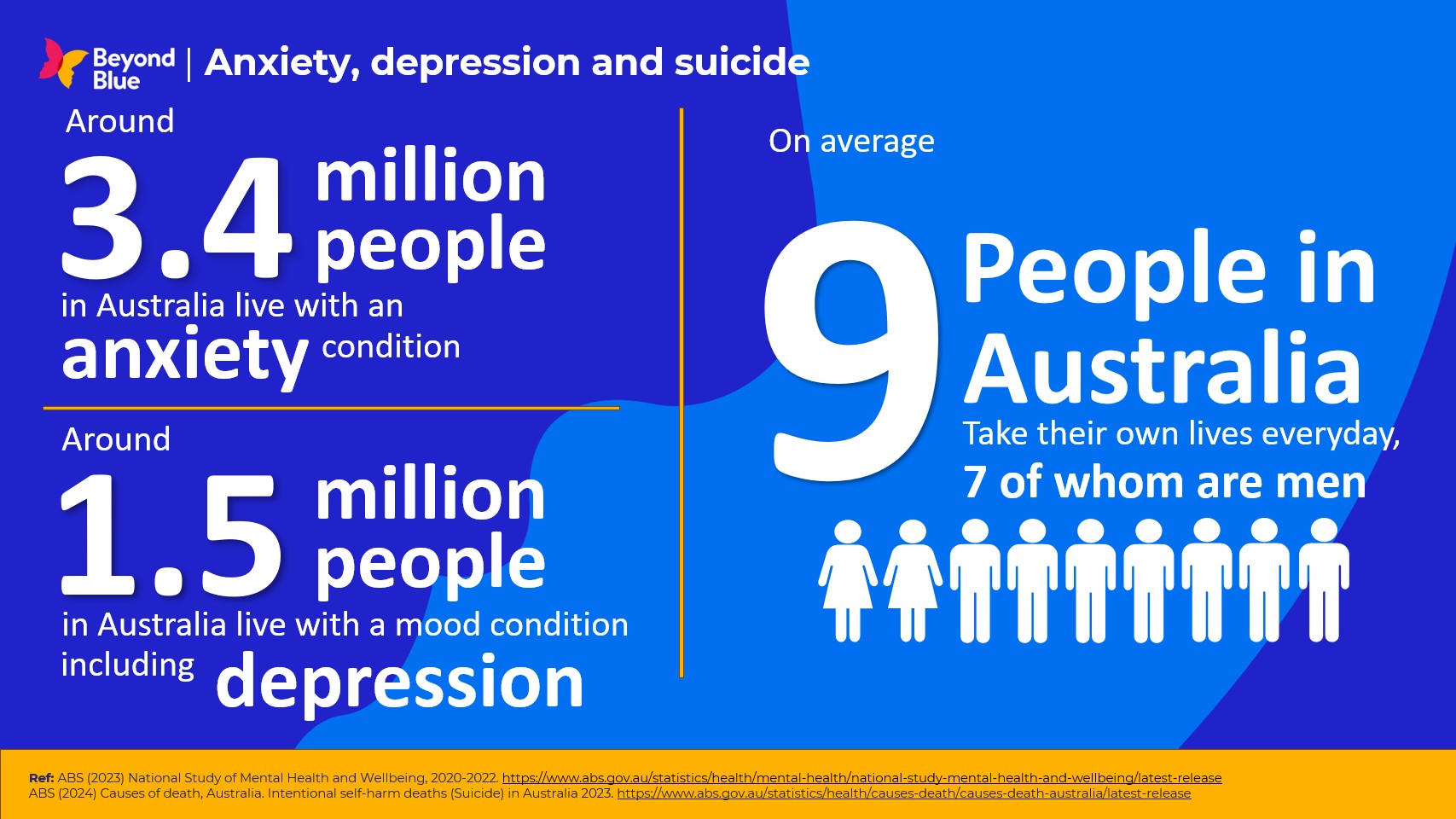
1.5 million people have experienced symptoms of mood disorders - including depression - in the past 12-months.
In 2020–2022, 7.5% of Australians aged 16–85 years (8.6% of Females and 6.5% of Males) had a 12-month Affective disorder. 1
3.4 million people have experienced symptoms of anxiety disorders in the last past 12-months.
In 2020-2022, 17.2% of Australians aged 16–85 years had a 12-month Anxiety disorder. Females (2.1 million, 21.1%) and Males (1.3 million, 13.3%). 1
One in six people in Australia experience high or very high psychological distress.
In 2020-22, 16.7% of Australians aged 16-85 years experienced high or very high levels of psychological distress. Females (19.4%) were more likely to experience high or very high levels of psychological distress than males (13.9%). 1
One in five people in Australia (3.4 million) saw a health professional for their mental health.
In 2020–2022, 17.4% of Australians aged 16–85 years saw a health professional for their mental health in the last 12 months. 1
More people are seeking support from mental health professionals for their mental health. Women and young people are the most likely to seek support.
In 2020–2022, there were 4.3 million Australians aged 16–85 years with a 12-month mental disorder. Of these, 1.9 million (45.1%) saw a health professional for their mental health.1 This has increased from 35% in 2007. 2 Females and people aged 16-34 years were more likely to have seen a health professional for their mental health (Females 51.1% compared with males 36.4%; people aged 16–34 years 46.2% compared with people aged 65–85 years 35.1%). 1
Young women are more likely to experience a mental health condition than young men.
Almost half of females (45.5%) aged 16–24 years and a third of males (32.4%) aged 16–24 years had a 12-month mental disorder. 1
Every day in Australia, nine people die by suicide, seven of them are men.
More than 3300 people died by suicide in 2024. For males: 2,529 deaths have been initially identified as being due to suicide. For females: There were 778 deaths due to suicide.3
* An anxiety disorder is defined by the ABS in this research as one or more of the following: panic disorder, agoraphobia, social phobia, generalised anxiety disorder, obsessive-compulsive disorder and post-traumatic stress disorder.
** An affective or mood disorder is defined by the ABS in this research as one or more of the following: depressive episode, dysthymia and bipolar affective disorder.
1 ABS (2023) National Study of Mental Health and Wellbeing, 2020-2022 Retrieved January 2025 from https://www.abs.gov.au/statistics/health/mental-health/national-study-mental-health-and-wellbeing/latest-release
2 ABS (2007) National Study of Mental Health and Wellbeing. Retrieved January 2025 from https://www.abs.gov.au/statistics/health/mental-health/national-study-mental-health-and-wellbeing/2007
3 ABS (2025) Causes of death, Australia. Intentional self-harm deaths (Suicide) in Australia 2024. https://www.abs.gov.au/statistics/health/causes-death/causes-death-australia/latest-release
First Nations Peoples are twice as likely to be psychologically distressed than non-Indigenous Australians.
Around one-third (32%) of Aboriginal and Torres Strait Islanders adult respondents with valid responses (K5 survey) had high or very high levels of psychological distress.1 This is two times higher than the proportion of people reporting high or very high levels of psychological distress among the general population (16.7%). 2
First Nations peoples are more than 2.5 times more likely to die by suicide.
In 2022, suicide accounted for 4.6% of all deaths among First Nations people in comparison to 1.6% of all deaths among non-Indigenous people. Both First Nations males and females experienced suicide deaths at a higher rate than their non-Indigenous counterparts. The rate of death by suicide for First Nations males was 2.6 times that of non-Indigenous males. The suicide rate for First Nations females was 2.5 times that of non-Indigenous females. 3
The rate of suicide among Indigenous young people is significantly higher than among non-Indigenous young people.
Suicide contributes to premature mortality in First Nations people, especially in younger age groups. Between the years 2018-2022, almost a quarter of all deaths (22%) of First Nations people aged between 0-24 years was a result of suicide, compared to 16.8% of deaths for non-Indigenous Australians aged between 0-24. 3
First Nations Peoples are three times more likely to be hospitalised for self-harm.
In 2022–23, the rate of intentional self-harm hospitalisations for First Nations peoples was over three times that of non-Indigenous Australians. From 2008–09 to 2022–23 the overall rate of hospitalised intentional self-harm for First Nations people rose steadily (from 203 to 295 hospitalisations per 100,000 population). 4
Discrimination and racism increase psychological distress experienced by First Nations peoples
Racism and racial discrimination are key determinants of health and wellbeing. Experiences of racism and racial discrimination are common for Aboriginal and Torres Strait Islander people and are associated with negative impacts on mental health and on social and emotional wellbeing. 5 Everyday racial discrimination could explain nearly half (47.4%) of the gap in psychological distress Aboriginal and Torres Strait people experience, compared to non-Aboriginal Australians. 6
1 AIHW (2024). Aboriginal and Torres Strait Islander people and primary health care: patterns of service use, preferences, and access to services. Retrieved January 2025 from https://www.aihw.gov.au/reports/indigenous-australians/first-nations-people-primary-health-care/contents/factors-affecting-use-primary-health-first-nations/independent-variables
2 ABS (2023) National Study of Mental Health and Wellbeing, 2020-2022 https://www.abs.gov.au/statistics/health/mental-health/national-study-mental-health-and-wellbeing/latest-release
3 AIHW (2025) National Mortality Database and ABS Causes of Death, Australia 2023. Available from Suicide among First Nations people. Retrieved 23 February 2025 from www.aihw.gov.au/suicide-self-harm-monitoring/data/populations-age-groups/suicide-indigenous-australians
4 AIHW (2024) Intentional self-harm hospitalisations among First Nations people. Retrieved January 2025 from https://www.aihw.gov.au/suicide-self-harm-monitoring/data/populations-age-groups/intentional-self-harm-hospitalisations-indigenous
5 Truong, M., Moore, E. (2023). Racism and Indigenous wellbeing, mental health and suicide. Commissioned by and published on AIHW. Retrieved January 2025 from https://www.indigenousmhspc.gov.au/publications/racism
6 Thurber, et al. (2022). Population-level contribution of interpersonal discrimination to psychological distress among Australian Aboriginal and Torres Strait Islander adults, and to Indigenous–non-Indigenous inequities: cross-sectional analysis of a community-controlled First Nations cohort study. The Lancet, 400 (10368), 2084 – 2094
1 1. ABS (2023) National Study of Mental Health and Wellbeing, 2020-2022. Retrieved January 2025 from https://www.abs.gov.au/statistics/health/mental-health/national-study-mental-health-and-wellbeing/latest-release
2 ABS (2023) National Study of Mental Health and Wellbeing, 2020-2022 https://www.abs.gov.au/articles/mental-health-findings-lgbtq-australians
3 Hill, A. O., Bourne, A., McNair, R., Carman, M. & Lyons, A. (2020). Private Lives 3: The health and wellbeing of LGBTIQ people in Australia.
4 ABS (2024) Mental health findings for LGBTQ+ Australians. Retrieved January 2025 from https://www.abs.gov.au/articles/mental-health-findings-lgbtq-australians#selected-measures-of-mental-health-for-lgbtq-populations
1 ABS (2023) National Study of Mental Health and Wellbeing, 2020-2022. Retrieved January 2025 from https://www.abs.gov.au/statistics/health/mental-health/national-study-mental-health-and-wellbeing/latest-release
2 ABS (2008) National Survey of Mental Health and Wellbeing: Summary of Results, 2007. Retrieved March 2025 from https://www.abs.gov.au/statistics/health/mental-health/national-study-mental-health-and-wellbeing/2007
3 Brennan N, Beames JR, Kos A, Reily N, Connell C, Hall S, Yip D, Hudson J, O’Dea B, Di Nicola K and Christie R (2021) Psychological distress in young people in Australia – Fifth Biennial Youth Mental Health Report: 2012–2020, Mission Australia, Sydney.
4 Hill AO, Lyons A, Jones J, McGowan I, Carman M, Parsons M, Power J and Bourne A (2021) Writing Themselves in 4: the health and wellbeing of LGBTQA+ young people in Australia [National report], monograph series number 124, Australian Research Centre in Sex, Health and Society, La Trobe University, Melbourne.
5 AIHW (2024). Deaths by suicide among young people. Retrieved January 2025 from https://www.aihw.gov.au/suicide-self-harm-monitoring/data/populations-age-groups/suicide-among-young-people
6 Haslam D, Mathews B, Pacella R, Scott JG, Finkelhor D, Higgins DJ, Meinck F, Erskine HE, Thomas HJ, Lawrence D, Malacova E. (2023). The prevalence and impact of child maltreatment in Australia: Findings from the Australian Child Maltreatment Study: Brief Report. Australian Child Maltreatment Study, Queensland University of Technology.
Remoteness is a major risk factor contributing to suicide and the likelihood that someone will die by suicide appears to increase further away from the city they live in.
In 2022–23, residents of 'Very remote' areas recorded a rate of 169 hospitalisations per 100,000 population, compared to that of residents in 'Major cities' (89 per 100,000 population). 1 In 2023, the rate for residents of 'Very Remote' areas (21.0 deaths per 100,000 population) was 2.1 times that of the rate for residents of 'Major Cities' (10.0). 2
Young people who live outside capital cities appear to be particularly at risk of self-harm and suicide.
In 2022-23, young people aged 15–19 had the highest rates of intentional self-harm hospitalisations from each remoteness area except 'Very remote' where 20–24-year-olds had the highest rate. The highest rate of intentional self-harm hospitalisations overall was in the 20–24 age group in 'Very remote' areas (435 hospitalisations per 100,000 population), followed by the 15–19 age group from 'Remote areas' (417 per 100,000 population). A similar pattern was seen with deaths by suicide as age-standardised suicide rates tended to increase with remoteness of place of residence.1
People in outer regional, remote or very remote areas of Australia face more barriers to accessing health care than people living in major cities, making it harder for them to maintain good mental health.
In 2023-24, those living in outer regional, remote or very remote areas (36.3%) reported waiting longer than they felt acceptable for a GP appointment than those living in major cities (26.0%). They were more likely to delay or not see a GP when needed (30.8% compared to 28.6% in major cities). 3
1 AIHW (2024). Suicide and intentional self-harm. Retrieved January 2025 from https://www.aihw.gov.au/suicide-self-harm-monitoring/summary/suicide-and-intentional-self-harm
2 AIHW (2024). Deaths by suicide by remoteness areas. Retrieved January 2025 from https://www.aihw.gov.au/suicide-self-harm-monitoring/data/geography/suicide-by-remoteness-areas
3 ABS (2024). Patient Experiences. Retrieved January 2025 from https://www.abs.gov.au/statistics/health/health-services/patient-experiences/latest-release
Most Australian worker’s experience a mental health condition in their lifetime.
A 2021 survey of over 10,000 Australian workers, found that 61.8% of working Australians have reportedly experienced a mental health condition during their lifetime. 1
Many workers believe their mental health condition is related to their workplace.
In a 2021 survey of over 10,000 Australian workers, nearly a quarter (22.3%) of respondents believe they have a mental health condition that their workplace caused or made worse. 1
Employee mental health appears to affect employee retention.
Poor mental health can contribute to reduced productivity, absenteeism, and for many, the intention to quit their job. A 2025 survey of more than 2,000 employees and HR leaders found that most (6 in 10) employees have considered quitting their jobs because of their mental health.
1 Superfriend (2021). Indicators of a Thriving Workplace. Unpublished.
2 Headspace (2025) Workforce State of Mind. Seventh Annual Workplace Mental Health Trends Report. Unpublished.